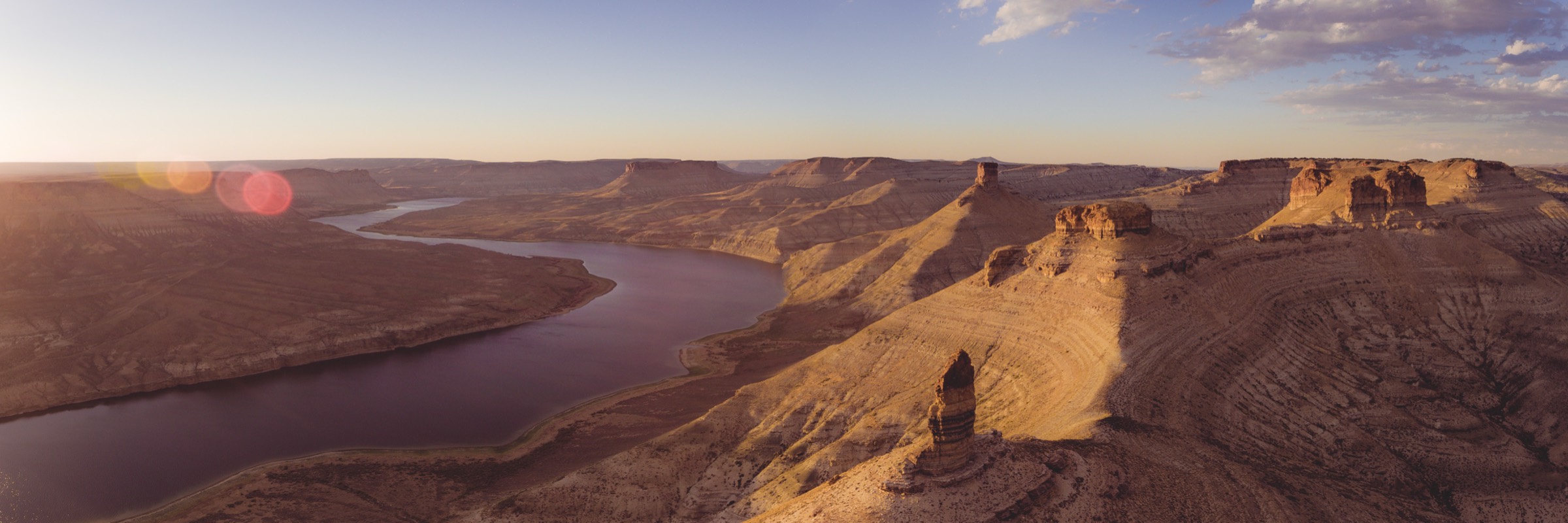
In 2024, I earned a Ph.D. in Geology from the University of Wisconsin–Madison, where my research focused on reading the sedimentary record to understand how rivers and lakes coevolved in southwestern Wyoming during a period punctuated by extreme global warming episodes called “hyperthermal events” between 50 and 60 million years ago. By tracing ancient watersheds at high resolution, my work offers a window into how Earth's hydrologic systems respond to climate change — and what those responses might tell us about our own future. As part of my research, I discovered an ancient river preserved in the rock record and worked to name it in collaboration with the Eastern Shoshone Heritage Center, honoring the ancestral keepers of the land.
Step into the boots of a field geologist and explore the quintessential research outcrop of Firehole Canyon in southwest Wyoming — no hiking required.
Visit a Virtual OutcropPublications
- Smith, M.E., Gregorich, H.G., Gipson, L.A., Krueger, R.C., Carroll, A.R., Parrish, E.C., Walters, A.P., Honig, S., Schwaderer, C., Meyers, S., Singer, B.S., Lowenstein, T.K., Arnuk, W.D., 2024. High-resolution X-ray fluorescence-based provenance mapping of Eocene fluvial distributary fans that fed ancient Gosiute Lake, Wyoming, USA. GSA Bulletin, v. 136(7-8), p. 2831–2844. doi.org/10.1130/B37207.1
- Parrish, E.C., Carroll, A.R., Gregorich, H., Smith, M.E., Schwaderer, C., 2024. Watershed-scale provenance heterogeneity within Eocene nonmarine basin fill: Southern Greater Green River Basin, western USA. GSA Bulletin, v. 136(5-6), p. 1787–1807. doi.org/10.1130/B36822.1
- Hammond, A.P., Carroll, A.R., Parrish, E.C., Smith, M.E., Lowenstein, T.K., 2019. The Aspen paleoriver: Linking Eocene magmatism to the world's largest Na-carbonate evaporite (Wyoming, USA). Geology, v. 47, p. 1020–1024. doi.org/10/gghxhq
Media
Ph.D. Defense Recording
Public defense of my doctoral dissertation on Eocene watersheds and geoscience education.
Chasing Sands
A short-film preview tracing the ancient rivers and shifting sands of southwest Wyoming.
Geoscience Education
Art-integrated Earth science curriculum
I'm interested in the use of film and other art forms as tools for deepening students' emotional connections to Earth science. During my Ph.D., I collaborated with the tadada Scientific Lab at UW–Madison to create curriculum-specific films for introductory geoscience courses — short educational videos designed not merely to convey information, but to inspire wonder and a sense of belonging in the discipline.
I found that the incorporation of art into introductory geoscience curricula had a measurable impact on students' sense of belonging, their sense of place, their interest in Earth science, and the recognition of their connectedness to the world around them. These findings suggest that the affective domain — the realm of emotions, values, and motivation — deserves far more attention in how we teach science.
Educational Videos
Minerals 101
An art-integrated introduction to minerals for introductory geoscience courses.
Sedimentary Rocks 101
An art-integrated introduction to sedimentary rocks for introductory geoscience courses.
Igneous Rocks 101 (Part 1)
An art-integrated introduction to igneous rocks for introductory geoscience courses — part one.
Igneous Rocks 101 (Part 2)
The igneous rocks series continues — part two.
Teaching Philosophy
My teaching philosophy centers on a simple conviction: students learn science more deeply when they first care about what they're learning. Too often, introductory courses front-load the what and how of science before students have any reason to find it meaningful. I prioritize the why — the wonder, the awe, the interconnectedness of our lives with the places we inhabit — because emotional engagement opens the door to lasting cognitive learning.
In practice, this means designing curricula that weave art, storytelling, and place-based experience into the fabric of geoscience instruction. Whether through short films that bring outcrop localities to life or classroom exercises that ask students to see geological processes through an artist's eye, my goal is to cultivate an affective connection to the material that carries students beyond the semester.
Full teaching philosophy in CV →